

Editor’s Column November 2025

 Save as PDF
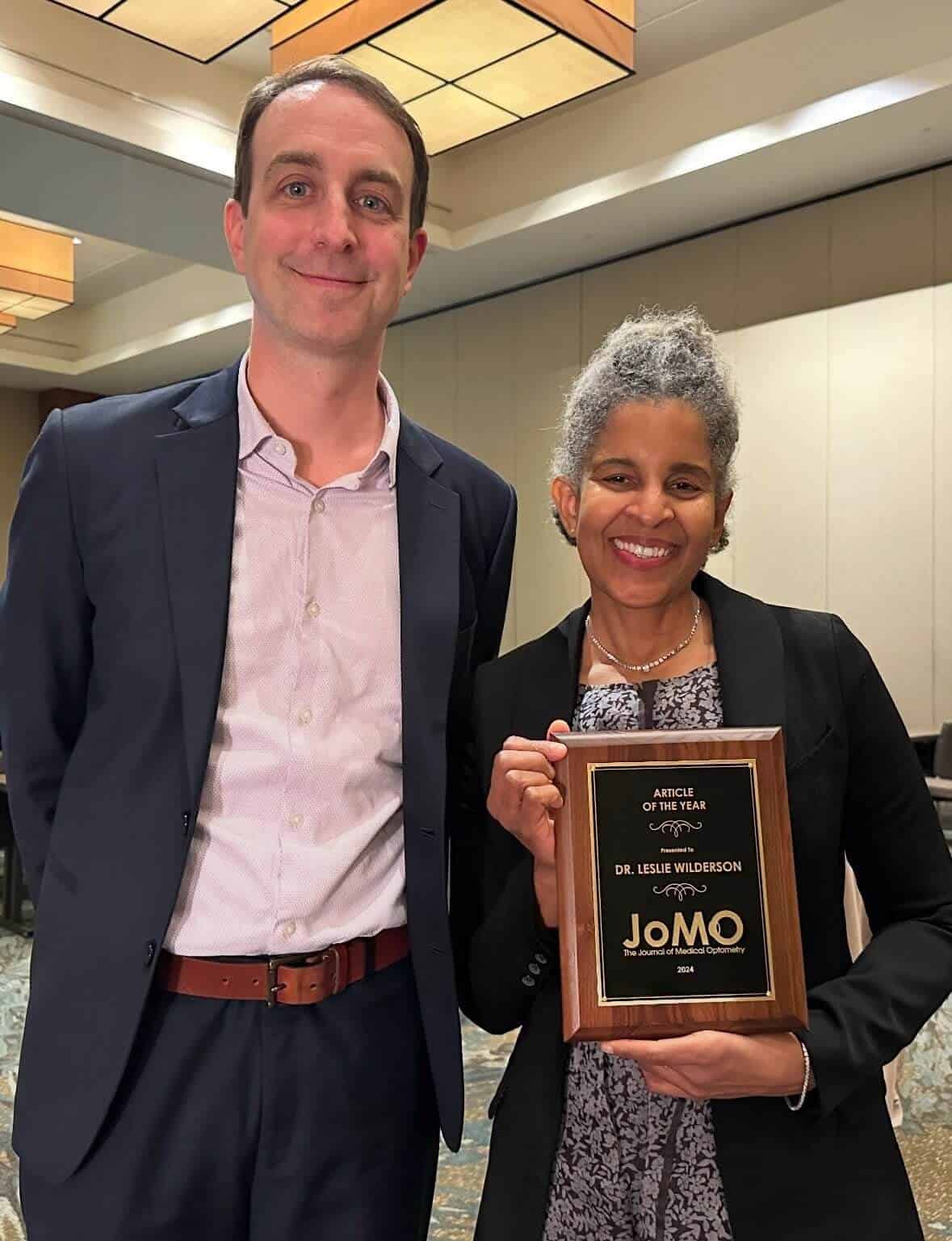
October saw the American Academy of Optometry meeting come and go in Boston. I was able to talk with many JoMO readers, editors and authors, and it was fantastic to hear the positive reception of the journal. We were also able to give away our second annual award for article of the year, which was presented to Dr. Leslie R. Wilderson during the annual NAVAO meeting. Dr. Wilderson is a staff optometrist with the Northeast Ohio VA Healthcare System and a Lieutenant Colonel in the United States Air Force Reserve. She wrote an article describing the use of OCTA to determine the activity of a neovascular membrane by using the shape and density of the lesion. The article coined the term “Quiescent Tomographically-Detected Macular Neovascularization.” The Editorial Board found it fascinating to learn about how the morphology and branching pattern of neovascularization – not just its presence or absence – was very important to determine activity. Congratulations to Dr. Wilderson!
In November, I was at the New England College of Optometry (NECO) Industry Collaborative. This is an annual meeting that NECO hosts where they invite representatives from many facets of our industry to meet with representatives from optometric education. It’s inspiring to hear people from different parts of our profession come together and share their expertise. This year, a talk about the difficulties optometry schools are facing really caught my attention. Optometry schools are asked to teach an increasing number of topics to their students, and there are only so many hours in the day. Time spent in clinics can be substantial, and it begs the question: if schools have to increase their didactic education time, will they have to decrease the time their students spend in clinics? If so, then how can students gain clinical education and experience? Would it require more mandatory clinical rotations after graduation? Should residencies be required for optometrists? Some kind of hybrid of the current situation?
Any change to the current paradigm would be difficult. But if one imagines a perfect scenario for students, it might involve them rotating through different clinics which are staffed with optometrists who are board-certified in different specialties. Each rotation would be shorter than the current three-month standard and would require the passage of an exam at the end of that specialty rotation, similar to the final year of a student in medical school. I don’t know what the right answer is to help schools better educate optometry students – in the classroom and out – but it’s probably time to talk about improvements we can make to the system that’s been used for decades. The profession of optometry is trending towards specialization; one doctor cannot be expected to be an expert in every aspect of the eye care optometrists provide. Shorter, specialized rotations would give students a better idea of what area they would want to specialize in for their careers, and it would give their future patients a doctor with deeper expertise in the needed field.
An example of this specialized expertise is the featured article this month: a report about a patient with Alice-in-Wonderland syndrome written by Dr. Marlin John. Dr. John is a specialist in vision rehabilitation and the perfect doctor to see a patient like this given his training and specialization. I learned a great deal from this article, not to mention that it’s a fascinating condition; it’s well worth your time. I’ll also direct your attention to the second edition of Diplopia Detective by Dr. Emily Carr. I like these articles; they are an approachable and engaging way to exercise that diplopia muscle, which is always a difficult but important thing to do. Thanks to all the readers, authors and supporters of the Journal of Medical Optometry.

Dr. Rett is the Editor-in-Chief of the Journal of Medical Optometry and the secretary for the American Board of Certification in Medical Optometry. He is the Chief of Optometry at VA Boston and sits on the national Field Advisory Board for Tele Eyecare at the VA. He is adjunct clinical faculty at several optometry schools, lectures nationally and enjoys writing about eyecare whenever and wherever.