


Blog
The Blog Module
The blog modules makes it easy to create a blog post feed in two different layouts.

Complications of a Giant Cavernous Carotid Artery Aneurysm
Cavernous carotid aneurysms (CCAs) differ from other intracranial aneurysms in that most are asymptomatic and are generally considered benign as there is a low risk of rupture. More common than complications from rupture are complications from the mass effect of the aneurysm itself on nearby structures.1,2 This report describes a case of a giant right CCA that progressed in size despite multiple surgical repairs that resulted in near- complete ophthalmoplegia and neurotrophic keratitis which led to a perforated corneal ulcer and subsequent enucleation.

PHOTO ESSAY: Unilateral Christmas Tree Cataract
A Christmas tree cataract is a rare, unique form of lens opacity. It typically appears as a group of several highly refractile colorful opacities that resemble ornaments decorating a Christmas tree, giving rise to its descriptive name. They are usually asymptomatic and discovered on routine examination. This case describes a patient with a Christmas tree cataract in the right eye.

Pesky Papilledema
A 41 y.o. Black female with HIV presented with intermittently blurred “fuzzy” vision in both eyes, peripheral numbness, nausea, and headaches…

Primary central nervous system diffuse large B-cell lymphoma presenting as homonymous hemianopia
Post-transplant lymphoproliferative disorder rarely affects the central nervous system although it can have visually significant consequences depending on the location of intracranial involvement.

What is the Best Evidence?
Imagine this: you are in your office scrolling through your unread emails and an email catches your eye with the subject line “kale consumption…
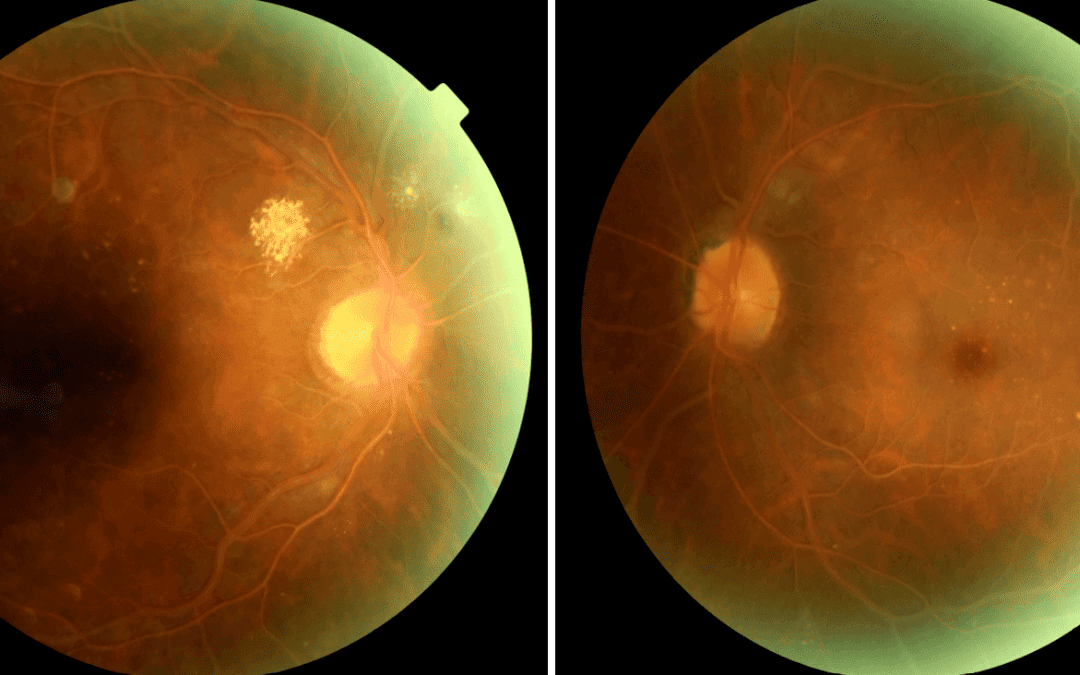
Retinopathy Prompting Laboratory Testing: a report of two cases
Lab testing, when directed by the retinopathy appearance and patient demographics, can serve as an helpful method of uncovering systemic disease…
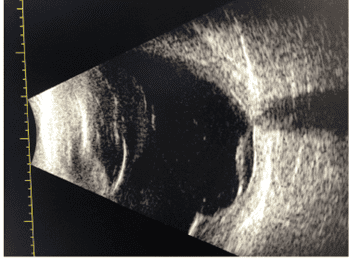
A Diagnostic Challenge of Scleromalacia Perforans
This case demonstrates the potential difficulty in separating anterior from posterior scleritis, along with the importance of uncovering whether an episode of scleritis is infectious or non-infectious in origin.
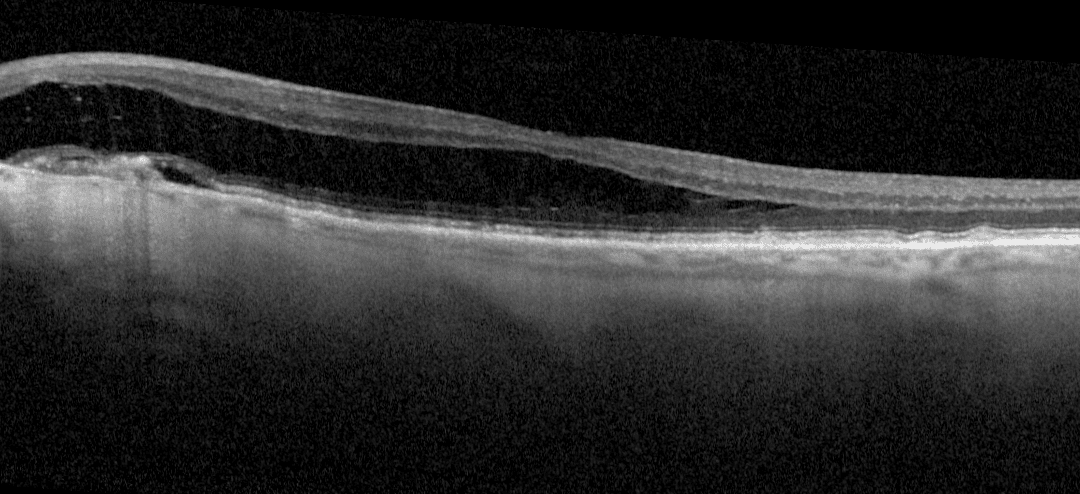
Lessons on Juxtapapillary Fluid
Fluid around the optic disc can come from a variety of sources. Clinical exam and accurate interpretation of ancillary studies, such as OCT or FA are…

Editor’s Column #2
As the Journal of Medical Optometry grows, I’m struck by the desire of so many of us to publish our work for the benefit of our peers. There is no shortage of submissions for publication; there is a demand by medical optometrists to have a space to call our own. I think we all benefit from this. The author benefits from being motivated to dig deeper into a case, into a disease. The reader benefits by being able to take away a better understanding of a condition they could easily see in their chair tomorrow. And, of course, the patient benefits when the field increases its shared knowledge.
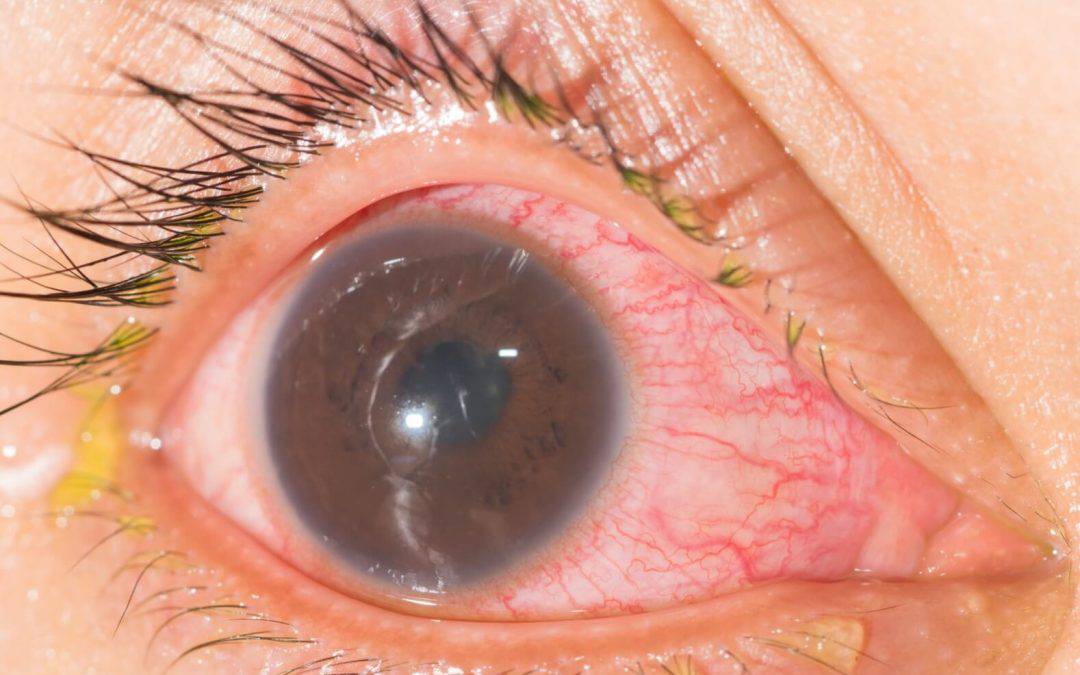
Uveitis: Laboratory Investigations and Current Recommendations on Diagnosis
Uveitis can pose a clinical challenge due to the vast array of differential diagnoses. However, optometrists are well-positioned to decipher the nuances…
Complications of a Giant Cavernous Carotid Artery Aneurysm
Cavernous carotid aneurysms (CCAs) differ from other intracranial aneurysms in that most are asymptomatic and are generally considered benign as there is a low risk of rupture. More common than complications from rupture are complications from the mass effect of the aneurysm itself on nearby structures.1,2 This report describes a case of a giant right CCA that progressed in size despite multiple surgical repairs that resulted in near- complete ophthalmoplegia and neurotrophic keratitis which led to a perforated corneal ulcer and subsequent enucleation.
PHOTO ESSAY: Unilateral Christmas Tree Cataract
A Christmas tree cataract is a rare, unique form of lens opacity. It typically appears as a group of several highly refractile colorful opacities that resemble ornaments decorating a Christmas tree, giving rise to its descriptive name. They are usually asymptomatic and discovered on routine examination. This case describes a patient with a Christmas tree cataract in the right eye.
Pesky Papilledema
A 41 y.o. Black female with HIV presented with intermittently blurred “fuzzy” vision in both eyes, peripheral numbness, nausea, and headaches…
Primary central nervous system diffuse large B-cell lymphoma presenting as homonymous hemianopia
Post-transplant lymphoproliferative disorder rarely affects the central nervous system although it can have visually significant consequences depending on the location of intracranial involvement.
What is the Best Evidence?
Imagine this: you are in your office scrolling through your unread emails and an email catches your eye with the subject line “kale consumption…
Retinopathy Prompting Laboratory Testing: a report of two cases
Lab testing, when directed by the retinopathy appearance and patient demographics, can serve as an helpful method of uncovering systemic disease…
A Diagnostic Challenge of Scleromalacia Perforans
This case demonstrates the potential difficulty in separating anterior from posterior scleritis, along with the importance of uncovering whether an episode of scleritis is infectious or non-infectious in origin.
Lessons on Juxtapapillary Fluid
Fluid around the optic disc can come from a variety of sources. Clinical exam and accurate interpretation of ancillary studies, such as OCT or FA are…
Editor’s Column #2
As the Journal of Medical Optometry grows, I’m struck by the desire of so many of us to publish our work for the benefit of our peers. There is no shortage of submissions for publication; there is a demand by medical optometrists to have a space to call our own. I think we all benefit from this. The author benefits from being motivated to dig deeper into a case, into a disease. The reader benefits by being able to take away a better understanding of a condition they could easily see in their chair tomorrow. And, of course, the patient benefits when the field increases its shared knowledge.
Uveitis: Laboratory Investigations and Current Recommendations on Diagnosis
Uveitis can pose a clinical challenge due to the vast array of differential diagnoses. However, optometrists are well-positioned to decipher the nuances…
Complications of a Giant Cavernous Carotid Artery Aneurysm
Cavernous carotid aneurysms (CCAs) differ from other intracranial aneurysms in that most are asymptomatic and are generally considered benign as there is a low risk of rupture. More common than complications from rupture are complications from the mass effect of the aneurysm itself on nearby structures.1,2 This report describes a case of a giant right CCA that progressed in size despite multiple surgical repairs that resulted in near- complete ophthalmoplegia and neurotrophic keratitis which led to a perforated corneal ulcer and subsequent enucleation.
PHOTO ESSAY: Unilateral Christmas Tree Cataract
A Christmas tree cataract is a rare, unique form of lens opacity. It typically appears as a group of several highly refractile colorful opacities that resemble ornaments decorating a Christmas tree, giving rise to its descriptive name. They are usually asymptomatic and discovered on routine examination. This case describes a patient with a Christmas tree cataract in the right eye.
Pesky Papilledema
A 41 y.o. Black female with HIV presented with intermittently blurred “fuzzy” vision in both eyes, peripheral numbness, nausea, and headaches…
Primary central nervous system diffuse large B-cell lymphoma presenting as homonymous hemianopia
Post-transplant lymphoproliferative disorder rarely affects the central nervous system although it can have visually significant consequences depending on the location of intracranial involvement.
What is the Best Evidence?
Imagine this: you are in your office scrolling through your unread emails and an email catches your eye with the subject line “kale consumption…
Retinopathy Prompting Laboratory Testing: a report of two cases
Lab testing, when directed by the retinopathy appearance and patient demographics, can serve as an helpful method of uncovering systemic disease…
A Diagnostic Challenge of Scleromalacia Perforans
This case demonstrates the potential difficulty in separating anterior from posterior scleritis, along with the importance of uncovering whether an episode of scleritis is infectious or non-infectious in origin.
Lessons on Juxtapapillary Fluid
Fluid around the optic disc can come from a variety of sources. Clinical exam and accurate interpretation of ancillary studies, such as OCT or FA are…
Editor’s Column #2
As the Journal of Medical Optometry grows, I’m struck by the desire of so many of us to publish our work for the benefit of our peers. There is no shortage of submissions for publication; there is a demand by medical optometrists to have a space to call our own. I think we all benefit from this. The author benefits from being motivated to dig deeper into a case, into a disease. The reader benefits by being able to take away a better understanding of a condition they could easily see in their chair tomorrow. And, of course, the patient benefits when the field increases its shared knowledge.
Uveitis: Laboratory Investigations and Current Recommendations on Diagnosis
Uveitis can pose a clinical challenge due to the vast array of differential diagnoses. However, optometrists are well-positioned to decipher the nuances…
Complications of a Giant Cavernous Carotid Artery Aneurysm
Cavernous carotid aneurysms (CCAs) differ from other intracranial aneurysms in that most are asymptomatic and are generally considered benign as there is a low risk of rupture. More common than complications from rupture are complications from the mass effect of the aneurysm itself on nearby structures.1,2 This report describes a case of a giant right CCA that progressed in size despite multiple surgical repairs that resulted in near- complete ophthalmoplegia and neurotrophic keratitis which led to a perforated corneal ulcer and subsequent enucleation.
PHOTO ESSAY: Unilateral Christmas Tree Cataract
A Christmas tree cataract is a rare, unique form of lens opacity. It typically appears as a group of several highly refractile colorful opacities that resemble ornaments decorating a Christmas tree, giving rise to its descriptive name. They are usually asymptomatic and discovered on routine examination. This case describes a patient with a Christmas tree cataract in the right eye.
Pesky Papilledema
A 41 y.o. Black female with HIV presented with intermittently blurred “fuzzy” vision in both eyes, peripheral numbness, nausea, and headaches…
Primary central nervous system diffuse large B-cell lymphoma presenting as homonymous hemianopia
Post-transplant lymphoproliferative disorder rarely affects the central nervous system although it can have visually significant consequences depending on the location of intracranial involvement.
What is the Best Evidence?
Imagine this: you are in your office scrolling through your unread emails and an email catches your eye with the subject line “kale consumption…
Retinopathy Prompting Laboratory Testing: a report of two cases
Lab testing, when directed by the retinopathy appearance and patient demographics, can serve as an helpful method of uncovering systemic disease…
A Diagnostic Challenge of Scleromalacia Perforans
This case demonstrates the potential difficulty in separating anterior from posterior scleritis, along with the importance of uncovering whether an episode of scleritis is infectious or non-infectious in origin.
Lessons on Juxtapapillary Fluid
Fluid around the optic disc can come from a variety of sources. Clinical exam and accurate interpretation of ancillary studies, such as OCT or FA are…
Editor’s Column #2
As the Journal of Medical Optometry grows, I’m struck by the desire of so many of us to publish our work for the benefit of our peers. There is no shortage of submissions for publication; there is a demand by medical optometrists to have a space to call our own. I think we all benefit from this. The author benefits from being motivated to dig deeper into a case, into a disease. The reader benefits by being able to take away a better understanding of a condition they could easily see in their chair tomorrow. And, of course, the patient benefits when the field increases its shared knowledge.
Uveitis: Laboratory Investigations and Current Recommendations on Diagnosis
Uveitis can pose a clinical challenge due to the vast array of differential diagnoses. However, optometrists are well-positioned to decipher the nuances…
Complications of a Giant Cavernous Carotid Artery Aneurysm
Cavernous carotid aneurysms (CCAs) differ from other intracranial aneurysms in that most are asymptomatic and are generally considered benign as there is a low risk of rupture. More common than complications from rupture are complications from the mass effect of the aneurysm itself on nearby structures.1,2 This report describes a case of a giant right CCA that progressed in size despite multiple surgical repairs that resulted in near- complete ophthalmoplegia and neurotrophic keratitis which led to a perforated corneal ulcer and subsequent enucleation.
PHOTO ESSAY: Unilateral Christmas Tree Cataract
A Christmas tree cataract is a rare, unique form of lens opacity. It typically appears as a group of several highly refractile colorful opacities that resemble ornaments decorating a Christmas tree, giving rise to its descriptive name. They are usually asymptomatic and discovered on routine examination. This case describes a patient with a Christmas tree cataract in the right eye.
Pesky Papilledema
A 41 y.o. Black female with HIV presented with intermittently blurred “fuzzy” vision in both eyes, peripheral numbness, nausea, and headaches…
Primary central nervous system diffuse large B-cell lymphoma presenting as homonymous hemianopia
Post-transplant lymphoproliferative disorder rarely affects the central nervous system although it can have visually significant consequences depending on the location of intracranial involvement.
What is the Best Evidence?
Imagine this: you are in your office scrolling through your unread emails and an email catches your eye with the subject line “kale consumption…
Retinopathy Prompting Laboratory Testing: a report of two cases
Lab testing, when directed by the retinopathy appearance and patient demographics, can serve as an helpful method of uncovering systemic disease…
A Diagnostic Challenge of Scleromalacia Perforans
This case demonstrates the potential difficulty in separating anterior from posterior scleritis, along with the importance of uncovering whether an episode of scleritis is infectious or non-infectious in origin.
Lessons on Juxtapapillary Fluid
Fluid around the optic disc can come from a variety of sources. Clinical exam and accurate interpretation of ancillary studies, such as OCT or FA are…
Editor’s Column #2
As the Journal of Medical Optometry grows, I’m struck by the desire of so many of us to publish our work for the benefit of our peers. There is no shortage of submissions for publication; there is a demand by medical optometrists to have a space to call our own. I think we all benefit from this. The author benefits from being motivated to dig deeper into a case, into a disease. The reader benefits by being able to take away a better understanding of a condition they could easily see in their chair tomorrow. And, of course, the patient benefits when the field increases its shared knowledge.
Uveitis: Laboratory Investigations and Current Recommendations on Diagnosis
Uveitis can pose a clinical challenge due to the vast array of differential diagnoses. However, optometrists are well-positioned to decipher the nuances…
Complications of a Giant Cavernous Carotid Artery Aneurysm
Cavernous carotid aneurysms (CCAs) differ from other intracranial aneurysms in that most are asymptomatic and are generally considered benign as there is a low risk of rupture. More common than complications from rupture are complications from the mass effect of the aneurysm itself on nearby structures.1,2 This report describes a case of a giant right CCA that progressed in size despite multiple surgical repairs that resulted in near- complete ophthalmoplegia and neurotrophic keratitis which led to a perforated corneal ulcer and subsequent enucleation.
PHOTO ESSAY: Unilateral Christmas Tree Cataract
A Christmas tree cataract is a rare, unique form of lens opacity. It typically appears as a group of several highly refractile colorful opacities that resemble ornaments decorating a Christmas tree, giving rise to its descriptive name. They are usually asymptomatic and discovered on routine examination. This case describes a patient with a Christmas tree cataract in the right eye.
Pesky Papilledema
A 41 y.o. Black female with HIV presented with intermittently blurred “fuzzy” vision in both eyes, peripheral numbness, nausea, and headaches…
Primary central nervous system diffuse large B-cell lymphoma presenting as homonymous hemianopia
Post-transplant lymphoproliferative disorder rarely affects the central nervous system although it can have visually significant consequences depending on the location of intracranial involvement.
What is the Best Evidence?
Imagine this: you are in your office scrolling through your unread emails and an email catches your eye with the subject line “kale consumption…
Retinopathy Prompting Laboratory Testing: a report of two cases
Lab testing, when directed by the retinopathy appearance and patient demographics, can serve as an helpful method of uncovering systemic disease…
A Diagnostic Challenge of Scleromalacia Perforans
This case demonstrates the potential difficulty in separating anterior from posterior scleritis, along with the importance of uncovering whether an episode of scleritis is infectious or non-infectious in origin.
Lessons on Juxtapapillary Fluid
Fluid around the optic disc can come from a variety of sources. Clinical exam and accurate interpretation of ancillary studies, such as OCT or FA are…
Editor’s Column #2
As the Journal of Medical Optometry grows, I’m struck by the desire of so many of us to publish our work for the benefit of our peers. There is no shortage of submissions for publication; there is a demand by medical optometrists to have a space to call our own. I think we all benefit from this. The author benefits from being motivated to dig deeper into a case, into a disease. The reader benefits by being able to take away a better understanding of a condition they could easily see in their chair tomorrow. And, of course, the patient benefits when the field increases its shared knowledge.
Uveitis: Laboratory Investigations and Current Recommendations on Diagnosis
Uveitis can pose a clinical challenge due to the vast array of differential diagnoses. However, optometrists are well-positioned to decipher the nuances…