
Category: Volume 2, Issue 1

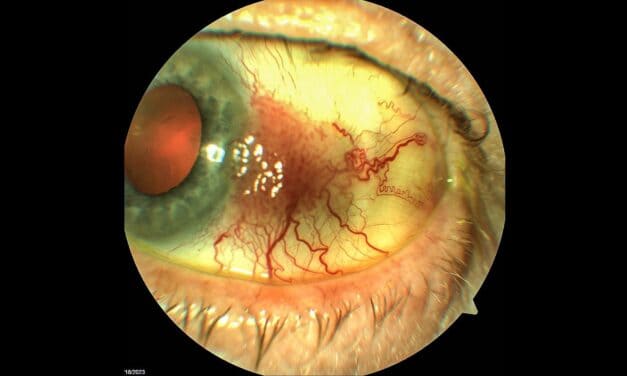
PHOTO ESSAY: “New” Red Eye – A Case of Conjunctival Intraepithelial Neoplasia

 Save as PDF

Ocular surface squamous neoplasia (OSSN) covers a wide range of ocular diseases that affect the squamous epithelial cells on the surface of the eye. This includes conjunctival intraepithelial neoplasia, corneal epithelial dysplasia, squamous cell carcinoma, and mucoepidermoid carcinoma. Anterior segment OCT can be used to differentiate between CIN and other benign conjunctival lesions, by evaluating for epithelial activity, stromal invasion, and corneal involvement.

Read More
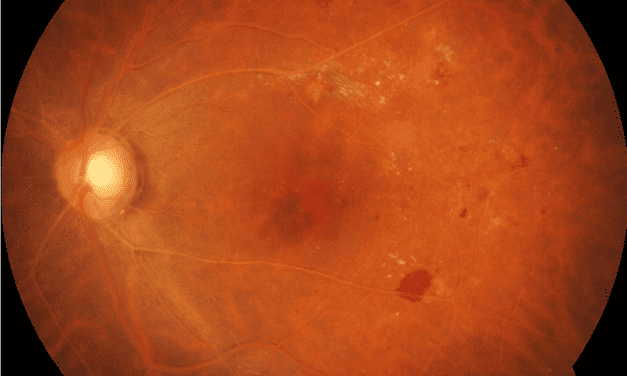
Torpedo Maculopathy

 Save as PDF

Torpedo maculopathy is a rare condition resulting in malformation of the outer retina. These lesions are often asymptomatic and found incidentally during routine eye examination. Although typically benign, there are rare reports of associated complications requiring treatment. Appropriate monitoring is thus required.

Read More

Charles Bonnet Syndrome Precipitated by Brimonidine Tartrate

 Save as PDF

Charles Bonnet Syndrome (CBS) induced by brimonidine tartrate ophthalmic solution has rarely been reported. CBS is a condition characterized by visual hallucinations in patients with vision loss and clear cognition. This condition is more prevalent in the elderly population, between the ages of 75 and 84 years old.

Read More

A Review of the Management of Fuchs Endothelial Corneal Dystrophy

 Save as PDF

Fuchs Endothelial Corneal Dystrophy leads to progressive visual deterioration that may cause acutely painful episodes. Medical management  has been limited to prescribing hyperosmotic agents. The advancement in therapeutic and surgical management has led to earlier intervention, better visual prognosis, and improved quality of life for patients affected by FECD. Optometrists play a role in the management of this condition’s diagnosis, treatment, and postsurgical care.

Read More

Sarcoid-Induced Uveitis: A Tattooed Journey

 Save as PDF

When a patient presents with an anterior uveitis that is suspicious for a systemic etiology, it is important to explore all areas of clinical care to determine the cause. Traditionally, the initial approach is to perform an appropriate lab work-up. Beyond this, areas of specialty that are typically considered include rheumatology, radiology, and infectious disease. However, this case report will present a patient that required intervention from dermatology to confirm the source of ocular inflammation.

Read More
Loading

In Partnership With

Subscribe


Our Authors

1 post(s)
General Practitioner from Mérida, Yucatán, and a proud graduate of UPAEP.
14 post(s)
Dr. Rett is the Editor-in-Chief of the Journal of Medical Optometry and the secretary for the American Board of Certification…
4 post(s)
Dr. Leslie Wilderson, OD, FAAO, Dipl AAO earned both her Bachelor of Science in Vision Science and Doctor of Optometry…
1 post(s)
Dr. Emily Coan graduated from the Southern California College of Optometry in 2025 and completed a residency in Ocular Disease…
5 post(s)
Dr. Canellos is a full-time faculty member of SUNY State College of Optometry. She is an Associate Clinical Professor, Instructor…
2 post(s)
Dr. Muscente is an optometrist practicing at Richmond University Medical Center and Level 1 Trauma Center. He is a graduate…
13 post(s)
Dr. Kane graduated from New England College of Optometry in 2015 and went on to complete an ocular disease/primary care…
1 post(s)
Dr. Glass earned her optometry degree from the University of Houston College of Optometry. Her training included rotations in ocular…
1 post(s)
Len Koh is a staff optometrist and residency site director at the Mann-Grandstaff VA Medical Center in Spokane, Washington. He…
1 post(s)
Dr. Wang graduated from the New England College of Optometry in 2025. She completed her ocular disease residency at the…